

MEDICAL WIRE MANUFACTURER / BUILT TO DRAWING
Custom Medical Wire Assemblies
From 3.5 mm equipment connectors to 2 mm electrode pins, MOOSEN brings material, connection and manufacturing experience to custom medical wire assemblies.
Engineered Around the Connection
Our work spans fine-wire materials, precision components and electrode connections. This wider view helps OEM teams develop a practical, repeatable assembly.
01 / Connection expertise
Equipment-side connectors and electrode-side pins are developed as one functional interface.
02 / Materials and assembly
Fine conductors, insulation, strain relief and branching are considered together.
03 / Production control
Visual, dimensional and electrical checks support consistent assembly output.
01 / PRODUCT OVERVIEW
Medical Wire Assemblies for OEM Device Programs
MOOSEN develops and manufactures medical wire assemblies that connect equipment, electrodes and other device interfaces. Our work brings together wire materials, termination geometry and practical assembly methods.
A 3.5 mm equipment connector with 2 mm pin terminations is one example of our custom approach. We also support branched layouts, identification and protective packaging, with engineering collaboration from sample development into production planning.
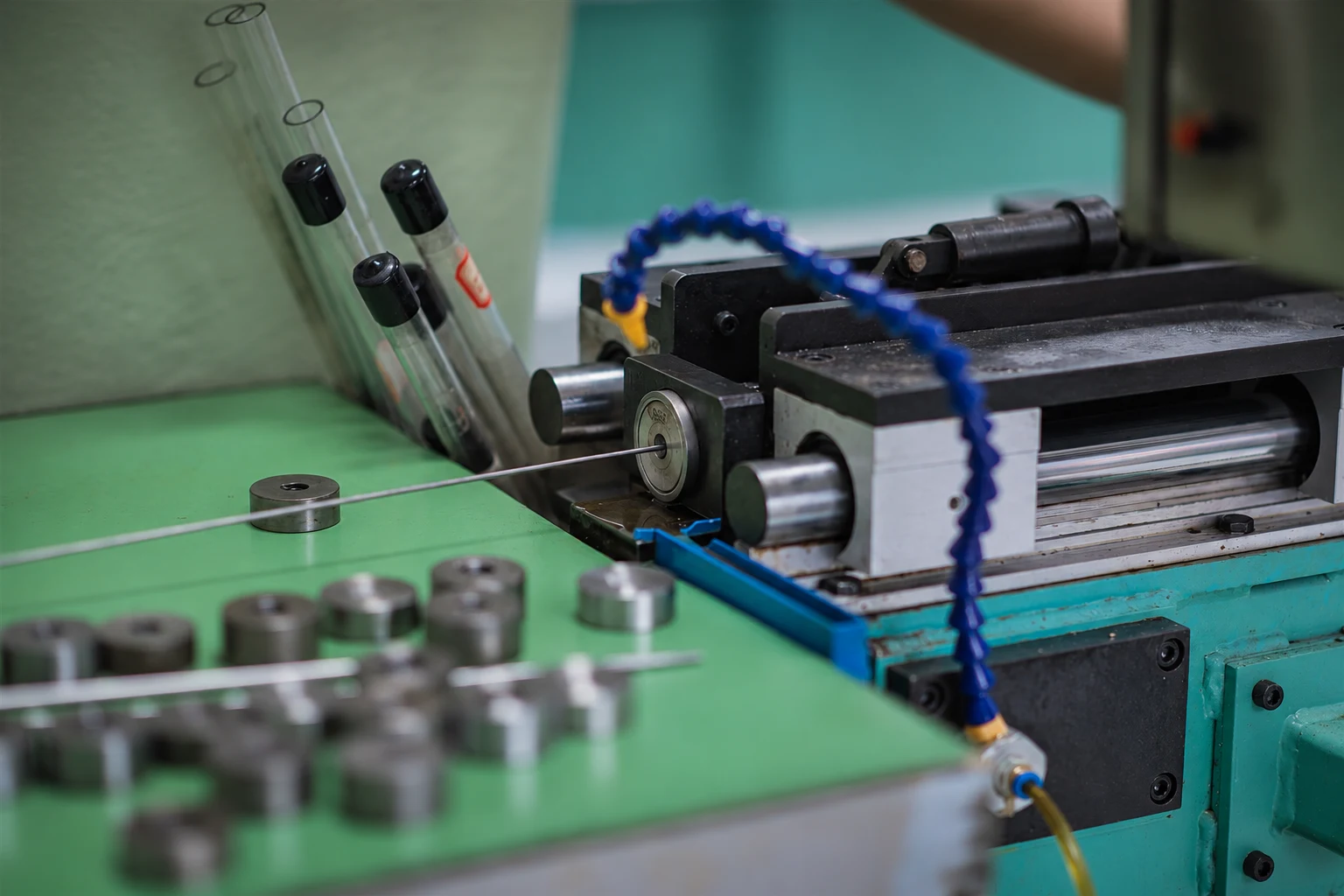
Wire processing equipment at the Moosen facility.
Connector integration
Equipment connectors, electrode pins and wiring are brought together in a complete assembly.
Mechanical design
Strain relief and cable routing are developed around the device connection.
Wire materials
Precious-metal and coated-wire experience informs conductor selection and construction.
Production finishing
Channel marking, inspection and packaging support repeatable supply.
02 / MANUFACTURING CAPABILITY
Medical Wire Manufacturing Capabilities
MOOSEN combines connection design, wire construction and controlled assembly. The examples below show the scope of our medical wire work.
| Capability | How MOOSEN supports it |
|---|---|
| Assembly scope | Electrode lead wires and custom medical connection cables |
| Equipment connection | 3.5 mm connector configurations and multi-channel wiring |
| Electrode connection | 2 mm pin terminations and other project-specific interfaces |
| Wire construction | Conductor, insulation, jacket and shielding options |
| Cable layout | Straight or branched assemblies with defined routing and length |
| Mechanical integration | Strain relief, connector retention and handling features |
| Quality control | Visual, dimensional and continuity checks as appropriate |
03 / CONFIGURATION
Custom Medical Wire and Cable Assembly Capabilities
Our engineering and production teams bring wire, connector and finishing details together in a manufacturable assembly.
Platinum wire (Pt) is a separate material capability
Platinum wire is part of MOOSEN’s broader material portfolio. It may be used in selected conductive or electrode components; a complete lead wire assembly is developed separately. Explore platinum-iridium wire and ETFE-coated medical wire.
04 / DEVICE APPLICATIONS
Medical Wire and Electrode Experience Across Device Programs
Electrode connection systems
Connection assemblies informed by MOOSEN’s work with electrode materials and contact components.
Medical equipment accessories
Custom cables that connect medical equipment with device-side interfaces.
OEM cable integration
Engineering collaboration on wire materials, routing and integration for OEM programs.
MOOSEN supplies components and assemblies for integration into customer-designed systems. Finished-device validation remains with the device manufacturer.

Moosen production facility.
05 / QUALITY APPROACH
Manufacturing and Quality at MOOSEN
Microscope inspection and other appropriate checks support verification of small features and assembly quality. Learn more about MOOSEN’s quality approach.

Microscope inspection at the Moosen facility.
01
Engineering review
Material, interface and assembly design are considered together.
02
Process definition
The manufacturing route and critical features are established for the configuration.
03
Sample development
Early assemblies allow the connection and handling concept to be evaluated.
04
In-process inspection
Visual, dimensional and continuity checks are applied where appropriate.
05
Controlled supply
Identification, packaging and available records support ongoing supply.
06 / RELEVANT EXPERIENCE
Experience Behind MOOSEN’s Medical Wire Work
Related OEM projects in neuromodulation and interventional devices bring fine-wire, precious-metal and inspection experience to MOOSEN’s medical wire work.
Neuromodulation components
An anonymized neuromodulation project involved spring wire and platinum-iridium rings for electrode-related components.
Interventional device components
MOOSEN has supplied platinum-iridium marker components for an interventional-device customer, drawing on precision-part manufacturing and inspection experience.
Select the right component for your assembly
Compare adjacent MOOSEN component forms by function and interface. These are design routes, not interchangeable stock sizes. Final feasibility, dimensions and acceptance are reviewed against your drawing.
| Component route | Choose it when | What to confirm |
|---|---|---|
| Medical wire assemblies | a wire or lead assembly with defined interfaces and termination | Use the approved drawing and assembly method as the decision basis. |
| Platinum–iridium wire supply | the scope is wire material supply | Review this component |
| Medical stranded wire | the scope is a stranded conductor | Review this component |
Prepare a useful RFQ
Please include the current drawing revision and the fields below where available. The contact form accepts a drawing or specification file; prototype quantity, annual volume and required records can be added there.
- conductor path
- Pt–Ir material
- insulation
- connector or termination
- handling
- testing and documentation
Evidence to agree: material documentation, critical dimensions, visual or electrical checks, sampling and release records as applicable to this component. No universal size, tolerance or performance claim is implied.
07 / QUESTIONS
Define the assembly and connector pinout
Send a drawing that identifies what the supplier must deliver for integration. Show each wire end, including any connector, exposed conductor or free lead. Confirm which items the supplier should source and which you intend to supply. MOOSEN documents wound signal leads and miniature feedthroughs as separate component categories. Check the exact combination since connector and assembly feasibility depend on how parts meet.
Supply a point-to-point pinout that pairs all circuit locations with their destinations. Label the connector drawing’s viewing side and identify the feature that locates pin one. Include unused positions and intentional common connections. Where an end terminates at an electrode or loose lead, assign it an identifier that can be carried into the inspection report. An approved pinout lets both teams test the same expected connections.
Dimension the cable in its delivered condition
Give the finished length, tolerance and reference points. Mating face to mating face and housing edge to housing edge can give different results on the same cable. Show breakout lengths, exposed leads and any connector orientation that affects routing. For a formed section, specify whether length is checked free or held in a drawing-defined position. If the cable depends on a housing or strain relief, show its controlled dimensions in the assembly view.
Keep the assembly drawing and component list at matching revisions. Specify approved connector and contact part numbers, conductor specifications and substitutions that require review. A drawing can identify incoming wire by reference and reserve circuit and dimensional acceptance for the delivered assembly. To compare conductor constructions before releasing that drawing, see medical micro wire materials.
Agree on electrical acceptance and batch records
Define the connections that must pass continuity and those that stay isolated. For end-to-end resistance, identify the test endpoints, limits and whether the reading includes both terminations. Where fixture resistance could affect a result, agree on the measurement method. A four-wire resistance measurement can reduce lead contributions when they are significant. For insulation or withstand tests, give each procedure its own conductor pairing, conditions and acceptance limit. See Cirris cable test definitions and Keithley resistance methods.
Agree which checks apply to every unit and which are performed on samples. If a fixture uses multiple connectors or is revision-specific, tie the result to the approved setup and pinout. For the pilot build, request actual readings where dimensions or electrical margins need review. At production stage, define the records to identify the assembly, lot, revision and electrical and dimensional test scope. State how those records connect to the packed part.
Before the pilot build, identify conditions that affect the check. If the assembly bends during installation, specify whether the electrical reading is made before or afterward and define its fixture position. Set change approval rules for revisions affecting pin assignment, connector orientation or cable length. Purchasing can then distinguish a repeat order from a change that requires a new drawing or sample review.
For recurring orders, provide package count and label fields so the shipper can preserve lot identity. Include any separation of development, pilot and production units. Start the quotation with the assembly drawing, end details, controlled pinout, finished length, tests and prototype and production quantities. When the equipment uses a 3.5 mm plug and electrode-side pins, see 3.5 mm to 2 mm pin electrode lead interfaces for the measurements to document.
Frequently Asked Questions
Can you customize a 3.5 mm to 2 mm electrode lead wire?
Yes. MOOSEN develops equipment-side to electrode-side connections, including 3.5 mm connector and 2 mm pin configurations for OEM programs.
What medical wire capabilities does MOOSEN offer?
Our work covers fine-wire materials, coated wire, electrode connections and custom cable assemblies. The right combination is developed with each device team.
Can you manufacture from a drawing or sample?
Yes. A drawing or representative sample can define the engineering requirements for sample development.
Can length, color and labels be customized?
Yes. Routing, channel identification and packaging can be developed around the complete assembly.
Do you support prototypes?
Yes. MOOSEN supports sample development and engineering review before production planning.
What tests are performed?
Visual, dimensional and continuity checks can be used where appropriate for the assembly. The inspection approach follows the final configuration.
Is platinum wire the same product?
No. Platinum wire is a material input. A lead wire assembly includes conductor, insulation, connector and terminations.
Are these finished medical devices?
No. The customer controls compatibility, regulatory strategy and finished device validation.
Can we source the conductor and contact components for a custom lead?
MOOSEN can quote drawing-defined platinum-iridium wire and contact components with the specified termination interface; the assembly scope is confirmed in the RFQ.
SEND YOUR SPECIFICATION
Looking for a Custom Medical Wire Manufacturer?
MOOSEN supplies drawing-defined medical wire components for device connections. Our engineering team supports interface design, sample development and manufacturing planning.