
PLATINUM–IRIDIUM · PRECISION RING COMPONENTS
Platinum Iridium Marker Rings
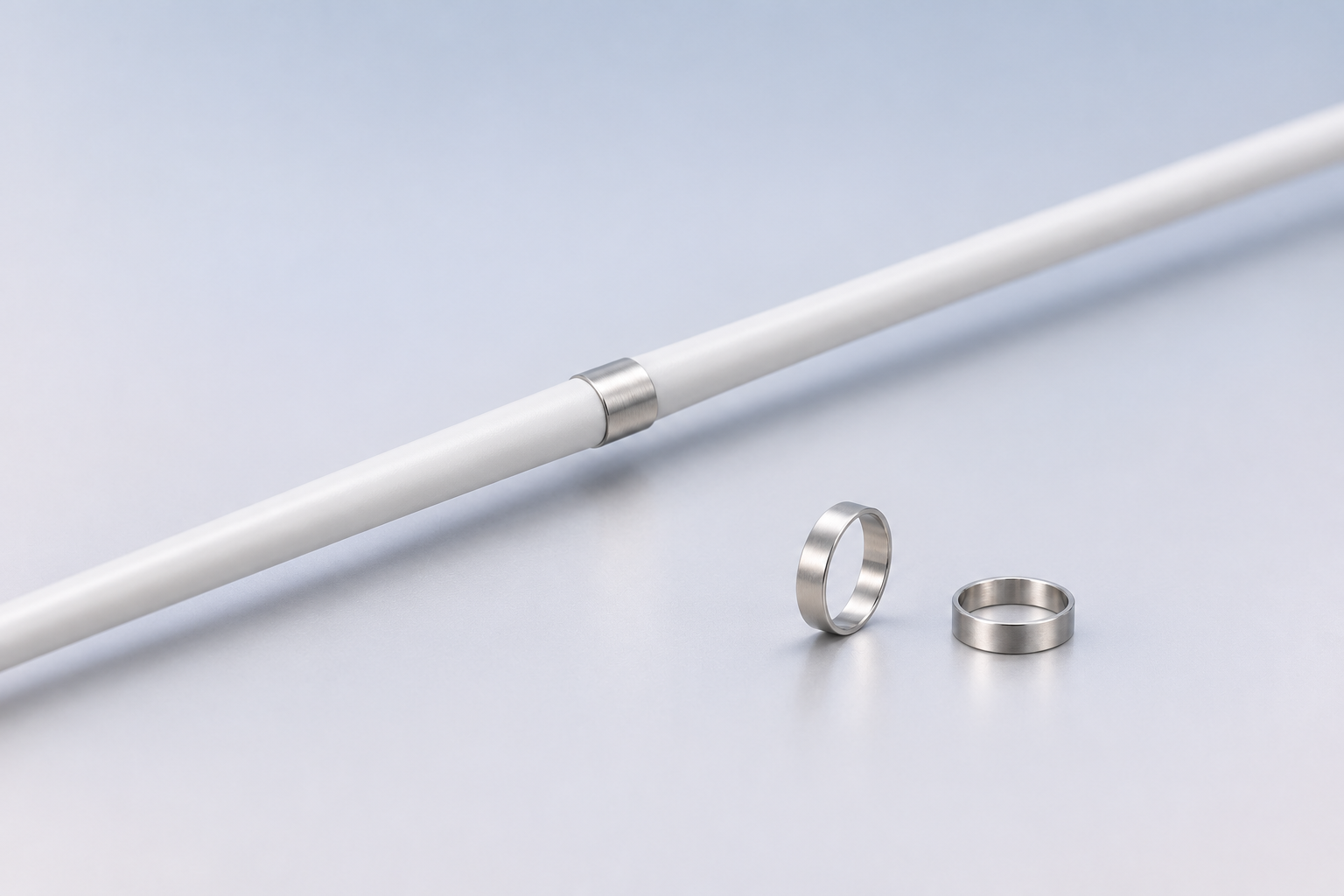
MOOSEN supplies selected standard Pt–Ir marker-ring sizes and manufactures custom rings for radiopaque position marking and electrical contact in customer-designed medical device assemblies. We bring alloy, miniature geometry, joining interfaces and inspection together in one component program.
Radiopaque markers · Electrode contacts · Custom geometries
Pt–Ir component experience
Rings within a broader precious-metal portfolio
Drawing-defined geometry
Small dimensions and special features reviewed together
Assembly-aware design
Ring fit considered with the mating shaft or lead
Inspection planning
Critical features checked to the approved drawing
TWO FUNCTIONS · ONE PRECISE FORM
A small ring with a defined job in the device
A platinum iridium marker ring can identify a position under fluoroscopy. When designed as an electrode, a related ring form can also provide an exposed electrical contact for sensing or stimulation. The function determines the surface, interface and verification approach.
MOOSEN offers selected standard marker-ring sizes and develops custom forms to customer drawings, including C-shaped, slotted and perforated options. For dedicated radiopaque tubing and band forms, see our platinum-iridium marker bands. For a wider material portfolio, explore our Pt–Ir precision components.
Radiopaque marking
Pt–Ir ring geometry can support location identification during X-ray guided procedures.
Electrical contact
Electrode ring designs address the exposed contact area and conductor connection.
Miniature fit
Inner and outer geometry is developed around the mating shaft, insulation and device envelope.
Controlled finish
Edges and surfaces are considered for assembly handling and the intended component function.
MOOSEN RING COMPONENTS
From alloy form to assembly fit
A useful marker-ring specification extends beyond diameter. MOOSEN engineers material form, wall thickness, length, edge condition and joining features together, with inspection tied to the approved drawing.
MOOSEN develops platinum-iridium rings for radiopaque marking, electrode contact and other drawing-defined functions. Final geometry and performance criteria are confirmed with the device manufacturer.
DRAWING-BASED CONFIGURATIONS
Platinum iridium ring capabilities
MOOSEN supports program-specific ring forms. The approved drawing and the component’s role in the device govern final dimensions, tolerances and inspection.
| Design area | MOOSEN approach |
|---|---|
| Alloy | Platinum–iridium grade selected to the approved material specification |
| Ring geometry | OD, ID, wall, width and tolerances according to drawing |
| Contact or marker area | Exposed surface and position defined for the device function |
| Edges and surface | Finish specified for handling, joining and contact requirements |
| Special features | Slots, openings and other features reviewed for manufacturability |
| Joining interface | Fit considered with lead, shaft, conductor or insulation |
| Inspection | Visual, dimensional and applicable electrical checks agreed by project |
DEVICE APPLICATIONS
Ring components across medical device programs
MOOSEN supplies components for integration into customer-designed systems. The device manufacturer validates the finished device.
Electrophysiology systems
Compact electrode contact forms for customer-designed mapping and treatment assemblies.
Neuromodulation leads
Pt–Ir ring components developed alongside fine wire and other lead components.
Catheter position markers
Radiopaque ring features for device position identification under imaging.
OEM device integration
Custom ring geometry and inspection aligned with a customer-controlled assembly.
PROJECT EXPERIENCE
Experience beyond a single ring
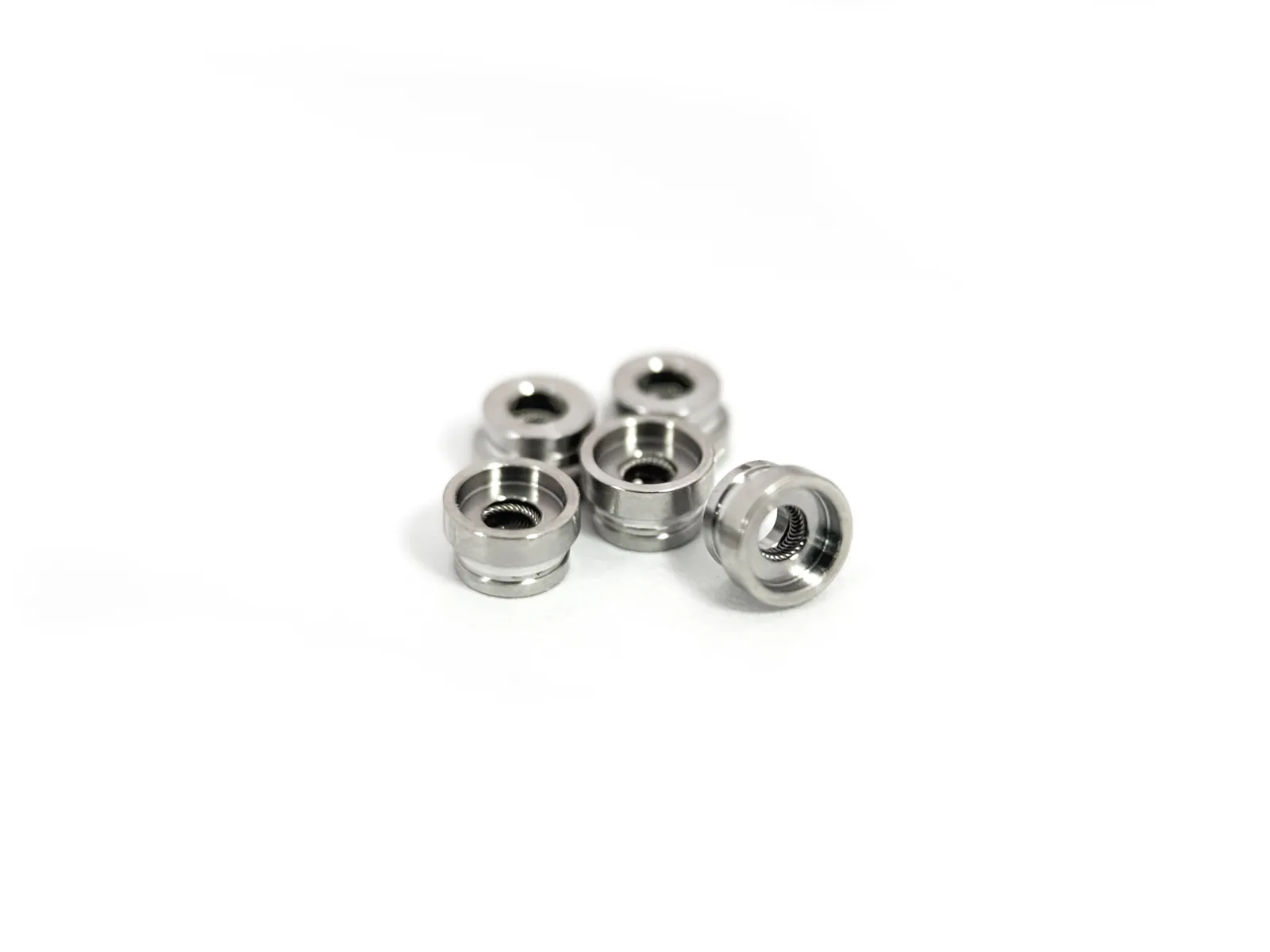
For a neuromodulation design, fine spring wire and Pt–Ir ring components can be specified within the same component scope. This experience informs practical discussions about material form, miniature metal features and how a ring meets the surrounding lead assembly.
MOOSEN also offers interventional marker components. These examples describe potential component configurations, not verified customer case studies or finished-device approvals.
What this means for a device team
MOOSEN combines precious-metal material expertise, precision ring production, assembly-fit engineering and drawing-based inspection within one component supply program.
MANUFACTURING & QUALITY
Manufacturing and inspection for miniature rings
MOOSEN combines precision component production with visual and dimensional review. Critical features and records are established for the approved project scope.


Engineering review
Material, geometry and joining features are considered together.
Sample development
Early parts support fit, finish and assembly evaluation.
Inspection
Microscope and dimensional checks address critical small features.
Select the right component for your assembly
Compare adjacent MOOSEN component forms by function and interface. These forms serve different device functions; selected standard ring sizes are available subject to current inventory. Final feasibility, dimensions and acceptance are reviewed against your drawing.
| Component route | Choose it when | What to confirm |
|---|---|---|
| Platinum–iridium marker rings | a discrete ring for positional visibility or an agreed secondary interface | Use the approved drawing and assembly method as the decision basis. |
| Platinum–iridium marker bands | a tubular shaft marker specified as a band | Review this component |
| Platinum–iridium electrode rings | an exposed electrical contact is the primary function | Review this component |
Prepare a useful RFQ
Please include the current drawing revision and the fields below where available. The contact form accepts a drawing or specification file; prototype quantity, annual volume and required records can be added there.
- ring ID/OD
- axial width
- placement
- surface
- attachment
- imaging objective
- acceptance method
Evidence to agree: material documentation, critical dimensions, visual or electrical checks, sampling and release records as applicable to this component. No universal size, tolerance or performance claim is implied.
FREQUENTLY ASKED QUESTIONS
Define the ring by the way it seats
A closed platinum-iridium marker ring has a continuous circumference. Show the shaft end or subassembly stage from which it will be loaded. Dimension the shoulder, groove or other feature that locates it. If the ring slides over another feature before reaching its seat, include the largest diameter it must pass. Draw the seat in section with the local shaft diameter, available axial length and the outer envelope after the ring is in place.
An open or C-shaped ring has a gap through the full axial length. Use an end view to define the gap as a width between specified points or an angle measured from the center. Show the gap position relative to the shaft if orientation matters. Where the OEM plans to approach the seat from the side, include the clearance in that assembly state. Side-loading review depends on the ring and shaft geometry, including any temporary opening or forming called for by the process.
For a slotted ring, show each slot in the finished ring view and the developed view if both define the part. Indicate whether the slot reaches an end face or stops within the wall profile. Dimension its position, width, length and end shape from the ring datums. If it must align with another feature after installation, give the installed orientation and tolerance. See Integer’s marker band and ring design examples.
Specify orientation, seating and installed profile
Give the assembler a reproducible reference for the angular position of the gap or slot. This might be a shaft, carrier or fixture feature visible during seating. State whether it remains accessible after the next assembly step. If the ends of a C-shaped ring are close to a shaft feature, dimension the required clearances. Include the condition in which angle and clearance are checked, especially if covering or attachment hides the feature.
Identify how axial end faces land in the seat and the maximum projection around the ring. This matters near an opening, where a single point can define the installed envelope. Give the relevant edge finish for the bore, ring ends and cut edges. A drawing that needs discrete holes through the wall should identify their individual size and position. See platinum-iridium perforated rings.
Measure the ring in the stated condition
Identify measurements for the free ring and those made with the ring held on a specified gauge or representative seat. Describe support during inspection, especially where a tool could move the ends of an open ring. Give the required views for gap width, slot geometry, end-face alignment and local projection. When the drawing separates free-state and installed limits, specify the condition to report for each reading.
For a repeat order, supply the approved drawing and the edge or dimensional characteristics that need shipment records. Include packing requirements that preserve ring shape or make orientation easy to inspect during receiving. A slotted and closed ring can have the same external diameter, so identify the geometry on the package when the same assembly uses more than one form. See MOOSEN quality information for the documentation to discuss.
If the drawing calls for a continuous tubular band controlled mainly by bore, outside diameter and length, see platinum-iridium marker bands. For an open, slotted or closed ring with a defined seat, send the part drawing, shaft section and inspection condition with the order requirements.
Platinum iridium marker ring FAQs
Are marker rings and electrode rings the same component?
They can share a compact Pt–Ir ring form, but their functions differ. A marker is intended for radiographic visibility; an electrode also needs an electrical contact interface. MOOSEN engineers the component to its specified function.
Can MOOSEN manufacture a custom platinum iridium marker ring?
MOOSEN manufactures platinum-iridium marker rings to customer drawings, with material, dimensions, edge condition, surface finish and assembly interface specified for the component order. Manufacturing feasibility is confirmed against the drawing.
Can a Pt–Ir ring be integrated with a lead or catheter shaft?
MOOSEN engineers ring geometry alongside the mating shaft, insulation, conductor and attachment method during component development.
What can MOOSEN inspect on a small ring?
Visual and dimensional checks can cover drawing-defined critical features. Electrical checks are considered when applicable to an electrode contact program.
Does MOOSEN supply a finished medical device?
MOOSEN supplies components for integration into customer-controlled devices. Finished-device validation and regulatory decisions remain with the device manufacturer.
Can the ring dimensions match our catheter shaft?
MOOSEN makes platinum-iridium marker rings to the customer’s shaft fit, OD, ID, wall and length requirements after confirming manufacturability.
Can samples be supplied for placement trials?
MOOSEN can quote drawing-defined samples for the buyer’s crimping, joining or placement evaluation before the production revision is approved.
TALK WITH MOOSEN
Develop a precision ring with MOOSEN
Send your ring drawing and intended function. MOOSEN can define the material form, precision geometry, assembly interface and inspection plan for your device program.