
PLATINUM-IRIDIUM · RADIOPAQUE COMPONENTS
Platinum Iridium Marker Bands for Catheters
MOOSEN supplies platinum-iridium marker bands that give catheter and delivery-system teams a radiopaque position reference under fluoroscopy. Check standard-size availability, compare marker band geometries or send a drawing for custom manufacturing.
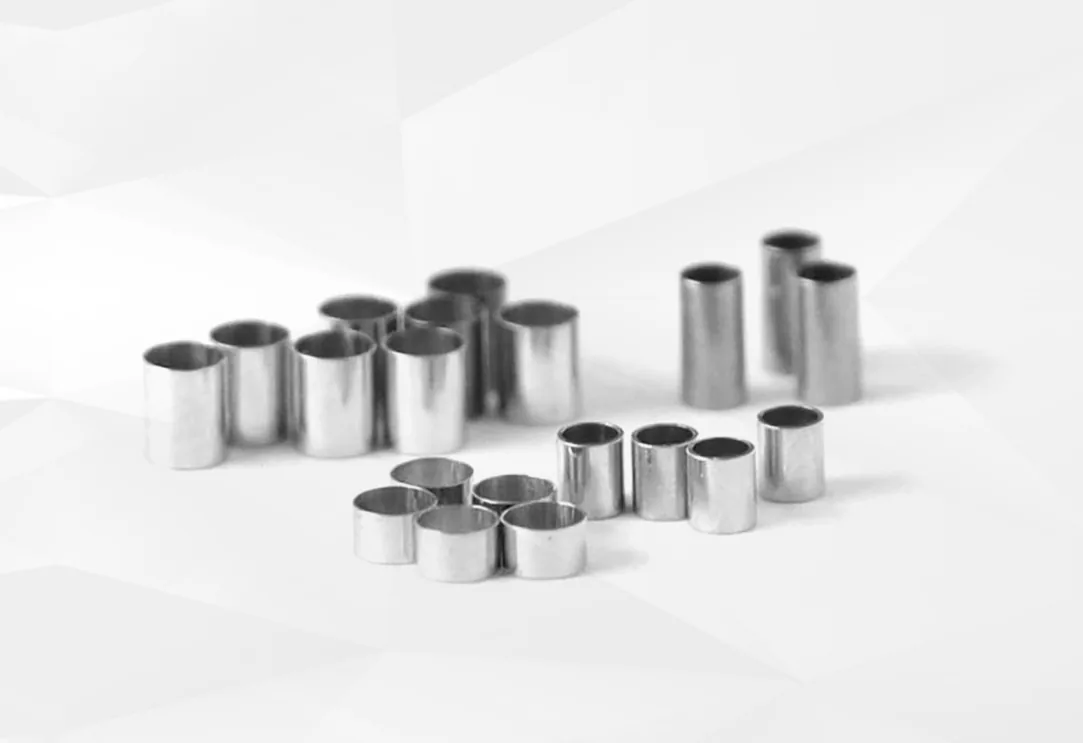
Sourcing Standard and Custom Pt–Ir Marker Bands
Standard Sizes
To check a standard size, send the alloy grade, inside diameter, axial length and quantity. Include either the outside diameter or the wall thickness. MOOSEN confirms availability for the requested size and quantity during quotation.
For early design work, it helps to identify which dimensions have room to change. You might have a fixed shaft diameter and some flexibility in band length, or a fixed outer profile and room to adjust the shaft at the marker location. Mention those constraints when you ask about available sizes. If you have a previously purchased part, a drawing or measured dimensions can help identify a matching configuration.
Custom Bands
Request a custom band when your design calls for specific dimensions, tolerances, materials or end conditions. A dimensioned drawing gives us the clearest basis for review. If several tolerances appear on the drawing, identify the dimensions that govern assembly fit or finished-device profile. Include the revision number when your team is evaluating more than one design.
For a prototype order, provide the initial quantity and identify any dimensions that may change after testing. If you expect a repeat order or a production requirement, share the estimated quantity separately. For C-shaped or slotted designs, see Platinum Iridium Marker Rings.
Marker Band Dimensions and Specifications
A marker band specification starts with the dimensions that govern fit and position. The inside diameter describes the opening that fits over the mating shaft. The outside diameter defines the band’s outer profile. Wall thickness describes the radial thickness of the band, and axial length defines how far it extends along the device. Show the units and tolerances on your drawing or in your inquiry.
| Specification | What to Include in Your Inquiry |
|---|---|
| Material | Specify the platinum-iridium grade if your design requires one. Include any material documentation requirements. |
| Inside diameter (ID) | Give the nominal ID and its tolerance. For a shaft-mounted part, include the mating shaft OD and tolerance if available. |
| Outside diameter (OD) | Give the nominal OD and permissible variation. Flag any maximum OD imposed by surrounding components or the finished assembly. |
| Wall thickness | State the required wall thickness and tolerance if they are controlled on the drawing. Identify which dimensions take priority when the print specifies ID, OD and wall thickness. |
| Axial length | Give the band length and tolerance. If the design uses more than one band, specify the length and quantity for each configuration. |
| Edge and surface condition | Describe the end faces, inner and outer edges, and mating surfaces. For perforated bands, include hole size, position and orientation. |
| Inspection and documentation | Identify the dimensions or characteristics to be verified and any reports or records required with the order. |
Dimensions That Affect Assembly Fit
For a band that slides over a shaft, provide the shaft diameter at the actual marker location. A shaft drawing may show several diameters along its length, so identifying the mounting area makes the intended fit clear. If the available space changes after another part is installed, share the relevant assembly view. If the band will sit within a recess, include the recess dimensions and any limit on how far the band can project above the surrounding surface.
If the band and shaft drawings are still being revised, send the known dimensions and flag the open ones. For example, you may already know the maximum assembled OD and band length while the mounting diameter is still under review. That information gives us a starting point for checking a standard size or reviewing a custom geometry. Final dimensions and applicable tolerances can be confirmed against the approved drawing.
Platinum-Iridium for Fluoroscopic Visibility
Radiopaque marker bands help identify selected device features under fluoroscopy. Platinum-iridium attenuates X-rays, helping the marker appear with contrast in the image. The marker gives the viewer a reference for its position on the device. A band near the distal tip can mark the tip region. Two bands can identify the ends of a working segment when the device design uses that arrangement.
When requesting a platinum-iridium marker band, include the alloy grade specified by your team, the target geometry and any imaging requirements relevant to the review. If the grade is still open, say so in the inquiry and share the space available for the band. Wall thickness and axial length are worth including early because they define the amount and distribution of material within that space.
Evaluate fluoroscopic visibility in the intended device configuration. The band geometry, nearby components, placement and imaging conditions all affect how the marker appears in the finished assembly. If you are comparing prototype configurations, note what changes between them, such as the band length or wall thickness. That makes it easier to identify which version you want quoted and to trace the tested configuration back to a specific drawing.
Applications in Catheters and Delivery Systems
Distal Position Marking
A band near the distal end of a catheter can provide a visible reference for the tip region. When preparing an RFQ, show the band position on the assembly drawing or identify the shaft section that carries it. Include the maximum profile allowed at that location and any edge requirements where the band meets an adjacent part.
Working-Segment Identification
A pair of bands can mark the ends of a working segment, such as a balloon working section. If your design uses different dimensions for the proximal and distal bands, identify each one separately on the drawing and in your requested quantities. If both positions use the same part, state the quantity of bands needed for the order so it can be distinguished from the number of device assemblies.
Delivery-System Position References
A delivery system can use a marker band to highlight the location of a selected feature during fluoroscopic imaging. Define the relationship between the band and the feature it marks, including any axial space limits. When shaft fit, attachment method or assembly tolerances determine the band geometry, see Custom Catheter Marker Bands and include the relevant assembly details with your RFQ.

Edge Finish and Dimensional Inspection
Small features on a marker band can matter during assembly. The inner edge may be the first part to contact the shaft as the band is installed. The outer edge can sit next to a sleeve or another component. The end faces define the band’s axial boundaries. If any of these surfaces have a specific functional requirement, mark the location on the drawing and describe the condition your team needs to verify.
A drawing note that identifies the affected edge or surface is easier to review than a general finish instruction. If the two ends have different requirements, label them in a detail view. If your team uses a visual acceptance criterion, include the applicable reference or describe the condition it addresses. For dimensions that control fit, state any specified measurement method or ask about inspection options during the quote review.
For supplier qualification, list the material records, dimensional inspection reports and lot identification your quality team requires. Specify which records you need for samples and repeat orders so MOOSEN can confirm them with the quote.

What to Ask a Platinum Iridium Marker Band Supplier
When comparing radiopaque marker bands from two suppliers, start with a single drawing revision and a common inspection plan. A quoted inside diameter tells you little about assembly fit if one supplier measures the opening at the edge and the other measures the bore behind the edge. Agree on measurement locations, units and the method used to check the thin wall. For a band with a specified end orientation, include a detail view so the inspection record shows which end was assessed.
During sample evaluation, track the band lot alongside the shaft revision and the conditions used to assemble it. Review fit, the resulting outer profile and marker position separately. If a sample meets its component drawing but sits too high on the shaft, check both mating dimensions and the assembly steps. This separates a component variation from a fit or process issue before your team freezes the drawing.
For repeat orders, identify which lot records your receiving team needs. The approved drawing, material designation, applicable dimensional report and packaging identification can be listed in the purchase requirement. If prototype and production orders use different inspection or packaging requirements, include both sets in the request so the commercial comparison reflects the same scope. Review MOOSEN’s quality and inspection capabilities and send any project-specific acceptance criteria with your drawing.
When to Consider Another Radiopaque Geometry
A closed metal marker band suits a shaft that can accept a continuous sleeve. If the marker must be positioned after a larger component is installed, review an open or slotted marker ring against the assembly sequence. When a port or feature must line up through the marker, specify the positional reference on a perforated band drawing. A thin-wall band may be worth reviewing when the assembled profile limits the radial space available for metal. Each choice changes which dimensions and edge conditions matter most at inspection.
For a longer hollow geometry, review the marker tube dimensions and specify how much axial space the tube can occupy. If your team is still choosing between tubular and flat formats, compare the available radiopaque marker formats before requesting a drawing review. For repeat orders with supplier qualification requirements, use the marker band manufacturing and purchasing guide to prepare the documents you want reviewed.
Marker Band FAQs
Is a band marker the same as a marker band?
In catheter and delivery-system documentation, “band marker” can mean the same thing as “marker band.” A metal marker band provides a radiopaque reference for a selected point or segment on a medical device. For example, a band can mark the distal region of a catheter, and a pair of bands can show the boundaries of a working section. MOOSEN supplies platinum-iridium bands for integration into catheter and delivery-system designs. See the radiopaque marker selection guide for other marker shapes.
How do I check whether a standard size is available?
Send the target ID, OD or wall thickness, axial length and quantity. Add the required alloy grade if your team has specified one. If you can accept a range for any dimension, include that range and identify the limits your assembly must meet. Standard-size availability is confirmed for the requested configuration and quantity.
Can MOOSEN quote a custom marker band from my drawing?
Yes. Send a dimensioned drawing with its revision, material, tolerances and any finish or inspection notes. If the band fits over a shaft or sits between other parts, an assembly view or the relevant mating dimensions can help clarify the fit. Include your initial order quantity and any estimated repeat requirements.
What should I send if I do not have a finished drawing?
Send the dimensions you know, the expected quantity and a short description of where the band will sit. A marked-up sketch is useful when it shows the mounting diameter, the available axial space and the maximum outer profile. Identify which values are preliminary so they can be discussed during the review.
Can I request inspection documentation with my quote?
Yes. List the records your quality team needs, such as material documentation or a dimensional report, and identify which dimensions the report should cover. Share any required format, lot identification or sampling instructions with the RFQ so the requested documentation can be confirmed during quotation.
Request a Marker Band Quote
Send your drawing or target dimensions to MOOSEN. For a standard-size inquiry, include the material, ID, OD or wall thickness, axial length and quantity. For a custom band, attach the drawing and flag the dimensions that govern fit, profile or marker position. Share any inspection or documentation requirements you need included in the quote.
If your drawing is still in progress, send the target dimensions and quantity. Include the most important assembly constraint, such as the mating shaft diameter, maximum allowed OD or available space along the shaft. Let us know if the request is for prototype evaluation or a repeat order, and include an estimated production quantity if you have one.
What Happens After You Send a Drawing?
Select Marker bands on the RFQ form, attach your drawing if available and describe the fit or imaging requirement. An on-screen confirmation tells you that your request has been saved for review.